

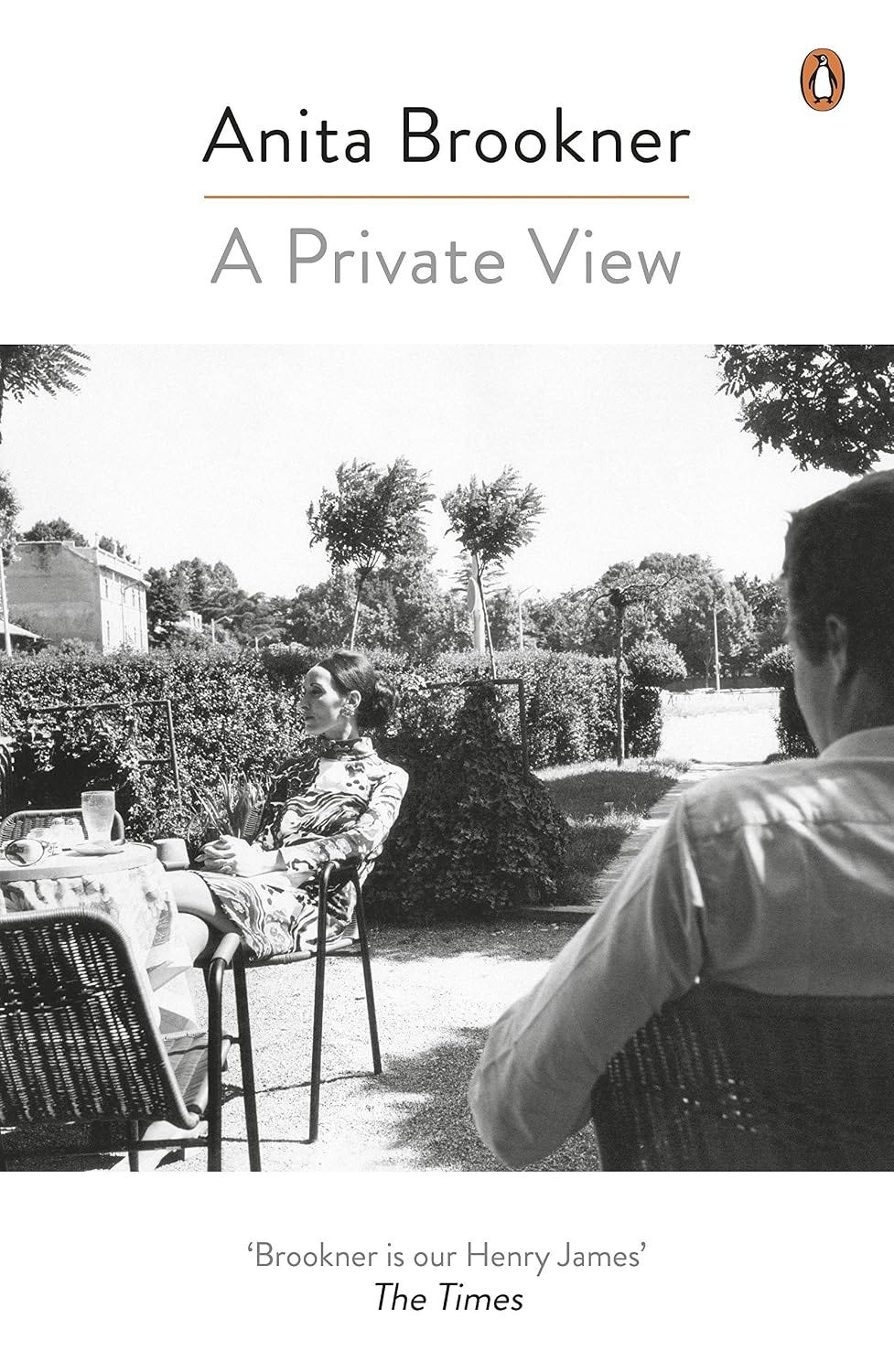
A Private View by Anita Brookner. This edition published in paperback by Penguin in 2016. Length: 224 pages
Sometimes a sombre mood requires a more solemn and contemplative introspective book and Anita Brookner can always be relied on to deliver that. I have read half a dozen of her twenty-four novels and A Private View struck just the same chord as any of Brookner’s other novels have. Who knew that my penchant for ‘spinster fiction’ would extend to include the melancholy bachelor? As usual with Anita Brookner, by the time I had reached page 100 I had already looked up six words in the dictionary. There is no denying that Anita Brookner’s novels are inclined towards a pensive mood but her darkly sharp wit is always present and her considered prose is layered with nuanced light and shade. Her observation is spot on and she creates instantly recognisable characters, guaranteeing total immersion in the novel.
The familiar Anita Brookner tropes were pleasingly present and if you are new to them, then I envy you, and if you are not, you will know exactly what I mean. Her economic prose conveys so much, exploring her usual territories of loneliness, interlopers and the quirks of human nature. This is spinster-fiction adjacent, not the bedsit variety this time but a more rarefied, beautiful but hollow, central London apartment and an unfulfilled romantic landscape. Typical of a Brookner novel, it might be light on plot but a great deal happens, even if it takes place mostly in the protagonist’s own head.
In essence: George Bland’s retirement travel plans are thwarted when his best friend and colleague Putnam dies suddenly, revealing the prospect of a rather solitary future existence. George, who worked his way up from humble beginnings to a senior executive position, spends his new found freedom reading, visiting galleries, taking walks from his comfortable central London apartment, lunching at his club and keeping up with dreary, regular Sunday afternoon telephone calls with Louise, a girlfriend from his distant past, now widowed, and the wife he failed to marry. Putnam’s death and his own retirement have left George downcast and unmoored. He’s given to morose introspection, harking back to a lonely childhood, neglected by selfish parents.
Everything changes when Katy Gibb arrives as a temporary neighbour in George’s building. Katy is flighty, selfish and manipulative. Young enough to be his daughter, she has designs on George but mainly for his potential to invest in her new-age health retreat scheme. Lurking on the sidelines is Louise, and the two women are filled with equal mistrust, jealousy and inhabit quite different worlds, even when they are in the same room. Katy interrupts George’s sombre pondering and provides a glimpse into previously unseen possibilities for the autumn of his life, if he is daring enough to put his principled respectability aside. Katy’s mercurial and dangerous charm bewilders George:
The supreme irony was that he had almost reached the end of his life before being visited by this powerful impulse to change it, and that the catalyst was someone of whom he equally powerfully disapproved. He could not solve this conundrum. He could only live through it and hope to survive it.
His attitude to Katy is in sharp contrast to his feelings for Louise:
Such pliancy, such docility! It was at times like these that he remembered why he had so nearly married her, and why in the end he had decided not to. Perhaps there was no need to marry her. The relationship had always lacked urgency, even at the beginning. They had felt like two members of an endangered species, huddling together for mutual protection. And even after all these years something of that feeling remained.
Thoughts and feelings: It may be intentional or just coincidence, or simply that I have very recently read Gwendoline Riley’s The Palm House, but I was struck by several similarities in these two novels. A Private View features George Bland, a recent retiree, mourning the loss of his colleague and best friend, Putnam. The Palm House features another Putnam who, like Brookner’s Bland, has a decades-long, unusual friendship with a significant ex-girlfriend. The commonalities do not end there; Riley’s character Laura and Brookner’s George Bland both reflect on their disappointing childhoods and the reader is left in no doubt how that has shaped their whole lives. I really enjoyed these parallels and compared Riley’s writing style to Brookner’s in my review of The Palm House here.
Who will enjoy this? If you have previously read and enjoyed any of Anita Brookner’s novels then you will be pleased to know that A Private View contains her usual unique storytelling flair and you will not be disappointed. R.C. Sherriff’s Greengates explores similar themes of retirement and mortality and several elements reminded me of Barbara Pym’s later, and the most serious of her novels, Quartet in Autumn.
Final thoughts: It is true that melancholy runs through the novel like a thread and Bland’s grief for Putnam and his loneliness is touching and palpable but the novel is elevated by Brookner’s wry observations and never bleak or without hope. Affected by his unsatisfactory upbringing, Bland has lived such a careful emotional existence that the maelstrom of grief for Putnam, combined with the shock of retirement, creates a perfect storm and presents him with a temptation hitherto unimaginable. Bland’s curious detachment and probable disdain for romantic relationships must surely stem from his mother’s rejection, and with the absence of the sanctuary that Putnam’s long friendship provided, he is left exposed and ripe for dark fairy Katy’s manipulation.
A Private View was originally published in 1994 and it really does contain the atmosphere of a different time. I was happy to return to 1990s London and to feel all of George Bland’s feelings. Maybe you will too.